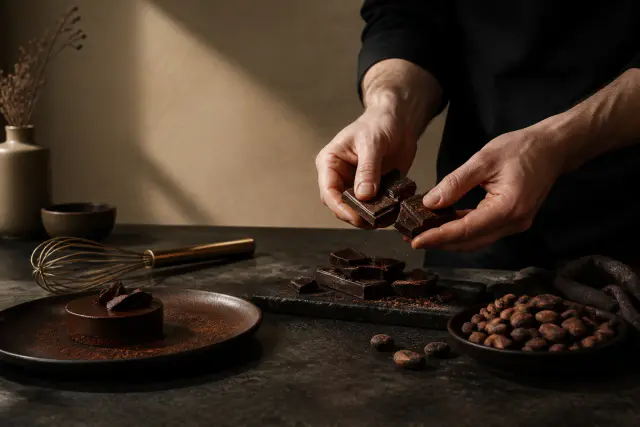
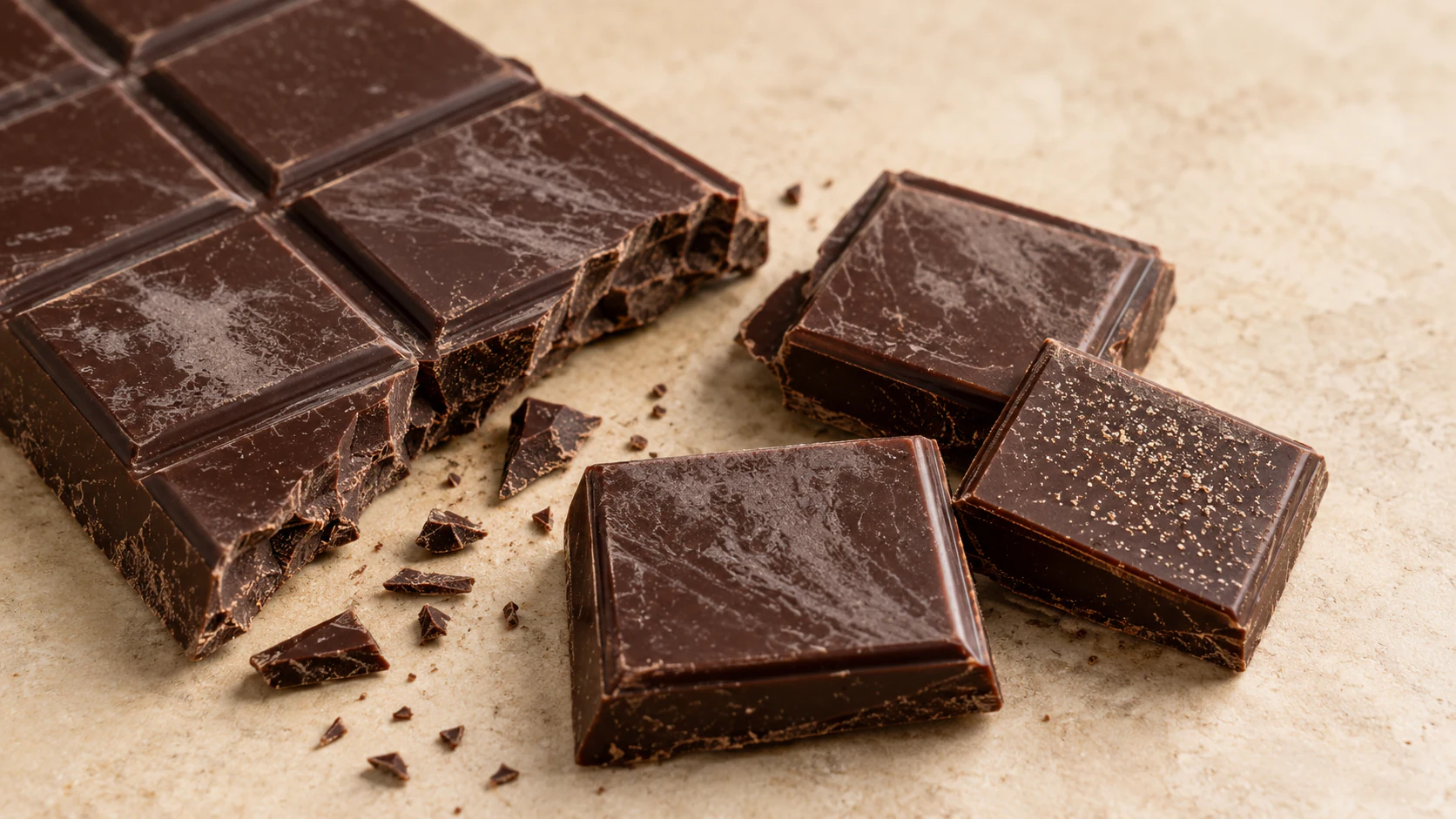
You open a wrapper and, instead of an even sheen, see dull patches, a greyish veil or tiny white spots. This may be chocolate bloom: the visible result of two different physical processes. One starts in the fat, the other in moisture, and appearance alone does not always distinguish them reliably.
A pale coating signals a change — it is neither a verdict on the cause nor a certificate of safety.
One pale surface, two different stories
Chocolate may look solid and still, but its microstructure is a sensitive system of cocoa butter, sugar and other particles. When the conditions around a product change, parts of that system can rearrange. The result appears where it is easiest to see: on the surface.
The term chocolate bloom usually covers two defects: fat bloom and sugar bloom. Both can reduce the expected sheen, smoothness and eating experience. Their causes differ, so a sound response starts with context rather than a firm conclusion: how was the product stored, was there moisture or a temperature change, and was the packaging intact?
Fat bloom: when cocoa butter rearranges
Cocoa butter can form different crystal structures. With well-controlled tempering, the aim is to give chocolate a stable structure, a clean snap and an even sheen. Heat, temperature fluctuations or an unstable initial structure can allow some fat to melt, move and recrystallise on the surface. The result may be a dull, greyish or marbled veil.
Filled chocolates can have a more complex story. A study combining MRI, NMR and HPLC–MS confirmed the migration of triacylglycerols from hazelnut filling through the chocolate shell towards the fat bloom. MRI tracked the movement, while NMR and HPLC–MS helped identify the chemical composition. This does not mean that every filled product will bloom; it shows why the same visible symptom can arise through more than one technological pathway.
Temperature has a measurable effect, but one figure should not become a universal at-home rule. A 2015 study followed seven types of chocolate products for 18 weeks under four conditions: 6, 12, 20 and 30 °C. At 30 °C, quality defects were strongest across all the products tested. This is a useful indication of heat-related risk, but the instructions on the specific product’s packaging remain the guide for that product.
Sugar bloom: the mark left by moisture
Water is the main factor in sugar bloom. Moisture on the surface dissolves a small amount of sugar. When the water evaporates, the sugar crystallises again and remains as pale dots, patches or a rougher layer. Condensation after a sudden move from a cold place to a warmer, humid environment is one possible scenario.
Texture can offer a stronger clue than colour: sugar bloom may look drier, grainier or more uneven. But it is only a clue. Lighting, the recipe, the filling and overlapping processes can all mislead the eye.
Can you tell the difference from a photograph?
A common comparison is useful: fat bloom more often looks like a smooth, greyish veil, while sugar bloom may look like white, rough or spot-like crystals. In practice, the boundary is not always so clear.
In one of three commercial products studied, Raman analysis and control tests found both fat and sugar components. This shows that mixed bloom is possible; it does not show that it is common in every product. Researchers use spectroscopy and controlled tests because a photograph cannot reliably reveal chemical composition. A photo taken at home is therefore a reason to investigate, not a laboratory diagnosis.
- Possible fat bloom: a dull, greyish or marbled film, often following heat or temperature fluctuations.
- Possible sugar bloom: whiter, spot-like or rough crystals associated with moisture.
- Possible mixed bloom: visual signs overlap, and appearance alone cannot confirm the cause.
Safety: the key word is “confirmed”
The Canadian Food Inspection Agency says that confirmed chocolate bloom may affect taste but, by itself, does not pose a health risk. It is easy to make an unsafe leap here: not every white, grey or mottled growth on a product is necessarily chocolate bloom.
If the packaging is damaged, there are signs of moisture, an unusual smell, coloured or fuzzy growth, an unknown storage history or any other cause for concern, do not taste the product to “check”. Set it aside and follow the instructions of the manufacturer, retailer or person responsible for quality. This article cannot diagnose a specific batch from a photograph.
What consumers and retailers can do
The most useful prevention is consistently simple: store the product in a cool, dry and stable environment, following the instructions on its own packaging. The main risk is not only a single high or low temperature, but frequent changes between environments, especially when condensation forms.
For a retailer, a pale coating is also an operational signal. Before a product is judged fit or unfit, check the batch, the condition of the packaging, transport, storage and display conditions, and the supplier’s instructions. A careful way to speak to a customer is “possible chocolate bloom that needs to be checked”, rather than automatically saying “it is safe”.
- Follow the storage temperature and conditions stated by the manufacturer for the specific product.
- Limit sudden temperature changes and exposure to moisture.
- If in doubt, set the product aside, record the batch and conditions, and contact the responsible person or supplier.
- Do not use a social media photograph as the sole basis for a food-safety decision.
A pale coating is a clue, not a verdict
A pale surface may tell a story about cocoa butter, moisture, filling, transport or temperature. It reminds us that chocolate is not only a flavour, but also a precise physical structure.
Good journalism and good retail practice do the same thing: they distinguish what is visible from what has been established. They name possible causes, explain the limits and leave the final assessment where it belongs — with the specific product, the specific batch and verifiable conditions.
In brief: fat can leave a veil, moisture can leave sugar crystals, and the eye cannot always tell which it sees. Stable, dry storage helps; the specific product still needs to be checked.