70%, 85%, 90% — the number on a chocolate bar is a useful guide to its composition. To make an informed choice, read it alongside the ingredients, the nutrition table and the wording that explains which product or component it refers to. Here is how to turn one percentage into a few precise questions.
Cocoa percentage starts the conversation about chocolate. The label and tasting give it substance.
One number, several expectations
On the shelf, two bars marked ‘85%’ can easily look like similar choices. We expect comparable sweetness, similar intensity and perhaps the same quality. Then we taste them: one melts more smoothly, the other leaves a drier sensation, and their aromas develop differently. Both labels can be entirely accurate.
The reason lies in the scope of the information. The percentage answers a question about cocoa content. The full recipe, processing and sensory experience require more information. For shoppers, this supports a more considered choice; for retailers, it provides a basis for explaining an assortment in concrete terms.
What ‘cocoa solids: 85% minimum’ means
Directive 2000/36/EC requires certain categories of cocoa and chocolate products to declare total dry cocoa solids using the wording ‘cocoa solids: …% minimum’. This total has two components: cocoa butter and dry non-fat cocoa solids.
For a plain chocolate bar without nuts or other inclusions, ‘cocoa solids: 85% minimum’ can be understood in practical terms as at least 85 g of total dry cocoa solids per 100 g of chocolate. The word ‘minimum’ matters: the declaration sets a lower limit.
This explanation has a specific scope. Special calculation rules apply to chocolate with nuts and other additions, while filled and composite products require you to check which component the percentage refers to. Start with the product name and the complete wording beside the number.
Cocoa butter counts too
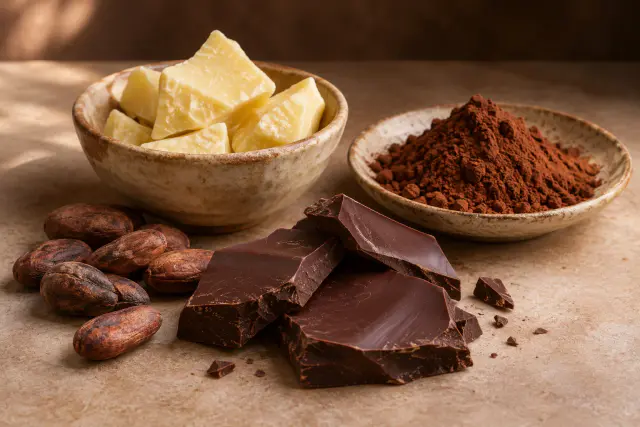
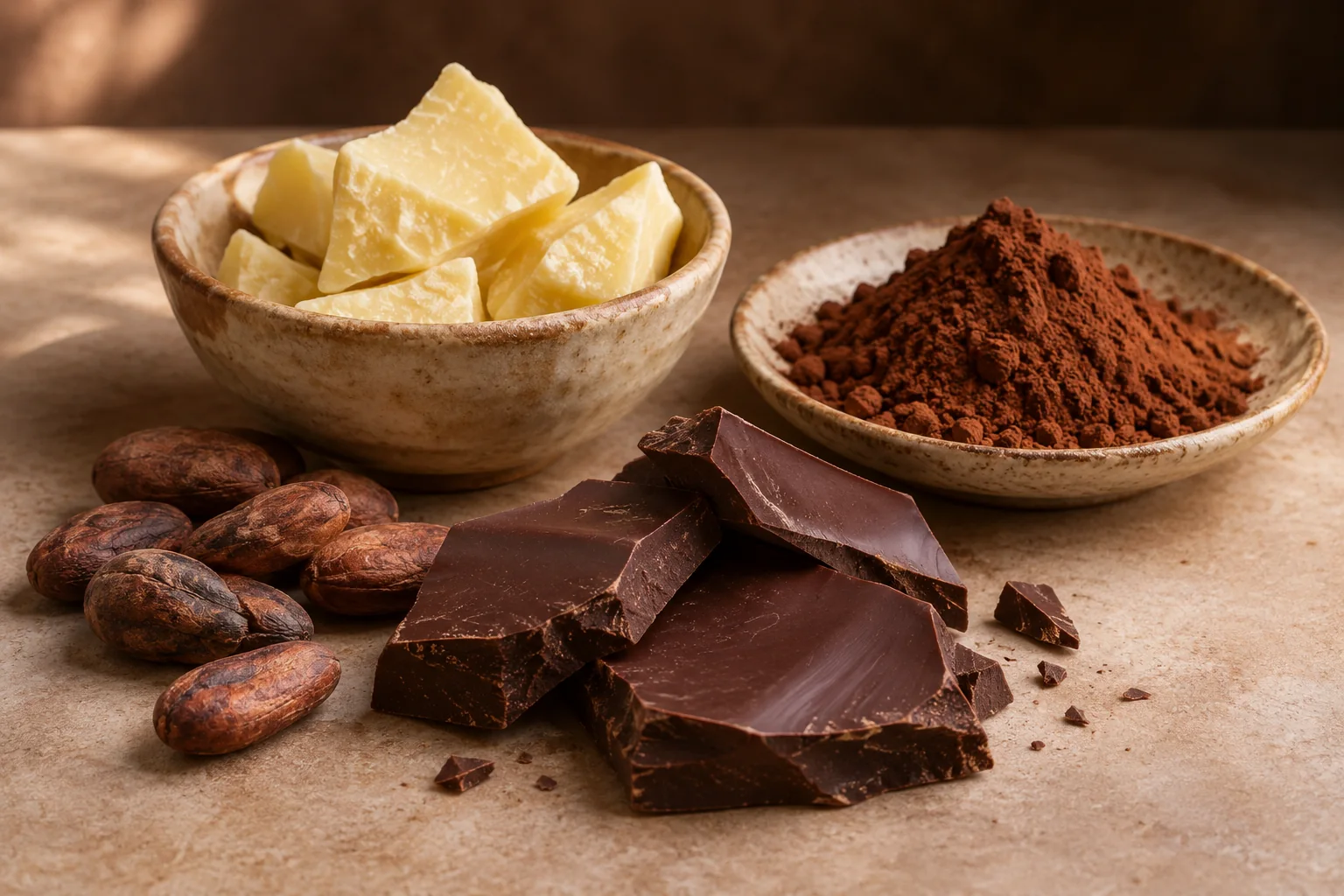
The word ‘dry’ may suggest that we are talking only about brown cocoa powder. Total dry cocoa solids also include cocoa butter, the fat naturally present in the bean. Pressing cocoa mass produces cocoa butter and cocoa press cake, from which cocoa powder is made.
The ingredients list may contain ‘cocoa mass’, ‘cocoa butter’ and ‘cocoa powder’. Cocoa mass contains both fat and non-fat components. Separately added cocoa butter also contributes to the total percentage. The percentage alone does not reveal the ratio between these two components.
The same cocoa content therefore allows for a different balance within the recipe. This is one reason why two chocolates with the same number can feel different as they melt. Exact quantities require product information from the manufacturer.
Why 85% cocoa does not mean 15% sugars
Subtracting ‘100 minus 85’ seems convenient. It does not, however, establish the amount of sugars. The declared percentage is a minimum, and the rest of the recipe can contain different ingredients. Depending on the product, these may include sugar, milk ingredients, an emulsifier or a flavouring.
For a comparison, turn the pack over and find the ‘of which sugars’ line per 100 g. It gives the total sugars in the food, including those naturally present, rather than added sugar alone. Cocoa percentage and the nutrition table answer different questions.
Always compare on the same basis. A value per serving on one pack and a value per 100 g on another are not directly comparable. If you want to compare sugars, use the per-100-g line for both products.
For a wafer or chocolate confection, first ask: a percentage of what?
‘Chocolate 30%’ in a wafer’s ingredients list and ‘cocoa solids: 70% minimum’ for the chocolate describe different quantities. The first may state the proportion of chocolate in the whole product; the second, the cocoa content of the chocolate itself. The filling, wafer sheet and other components have their own recipes.
This is a hypothetical example of label reading, unrelated to any particular Laica or Lago product. Do not infer the overall cocoa content of a composite product from a single number. Read any explanations in brackets and request the product specification if the information remains unclear.
In a product listing, keep the number connected to its component. ‘Dark chocolate with a minimum of …% cocoa solids in the coating’ conveys more precise information than a percentage placed on its own, which could be understood as describing the whole chocolate confection. The exact wording should follow the product’s label.
Flavour has more than one variable
Cocoa has a history long before it reaches the chocolate factory. Genetic material, the growing environment and post-harvest practices all help shape its sensory profile. ICCO considers these factors together when describing fine flavour cocoa.
Fermentation and roasting develop different stages of the cocoa’s aromatic potential. Grinding, mixing and conching follow, with further changes in flavour during conching. A single number on the pack cannot contain that entire journey.
That is why ‘85%’ is not a score of ‘8.5 out of 10’. A higher percentage may suit your preferences, but it does not automatically rank all chocolates by quality. Aroma, balance, texture and aftertaste require tasting under comparable conditions.
A small tasting with the same cocoa percentage
Choose two chocolates from a similar category with the same declared percentage. Read the labels and note the differences in ingredients. Bring the samples to a similar temperature and taste small pieces of a similar size. This is a practical comparison, not a laboratory test.
Smell each sample, then follow how it melts. Note your first impression, how the aroma develops and the aftertaste that remains. Use your own words: cocoa, fruity, nutty, roasted; smooth, grainy, dry. A ‘nutty’ flavour association does not in itself prove that nuts are present — check the ingredients and allergens on the label.
Finally, see whether your preference matches what you expected from the percentage. The difference between expectation and experience is precisely what makes the exercise useful.
Five checks for your next choice
When choosing chocolate for yourself or for your store’s assortment, read the information in this order:
- Product name: what exactly are you holding?
- Scope: does the percentage refer to the whole chocolate or to a particular component?
- Ingredients: which cocoa ingredients and other ingredients are listed?
- Nutrition table: how much sugar is declared per 100 g?
- Sensory profile: what does tasting reveal, and which occasion might the product suit?
If you are selecting an assortment for your business, contact STOK Dolce Vita for product information on specific Laica and Lago items.
Sources
- Directive 2000/36/EC — Article 3 and Annex I; consolidated text of 18 November 2013
- Regulation (EU) No 1169/2011 — Articles 18, 22 and 30–32 and Annex I; consolidated text of 1 April 2025
- ICCO — Processing Cocoa: cocoa mass, cocoa butter and processing
- ICCO — Fine Flavor Cocoa: factors that shape the sensory profile