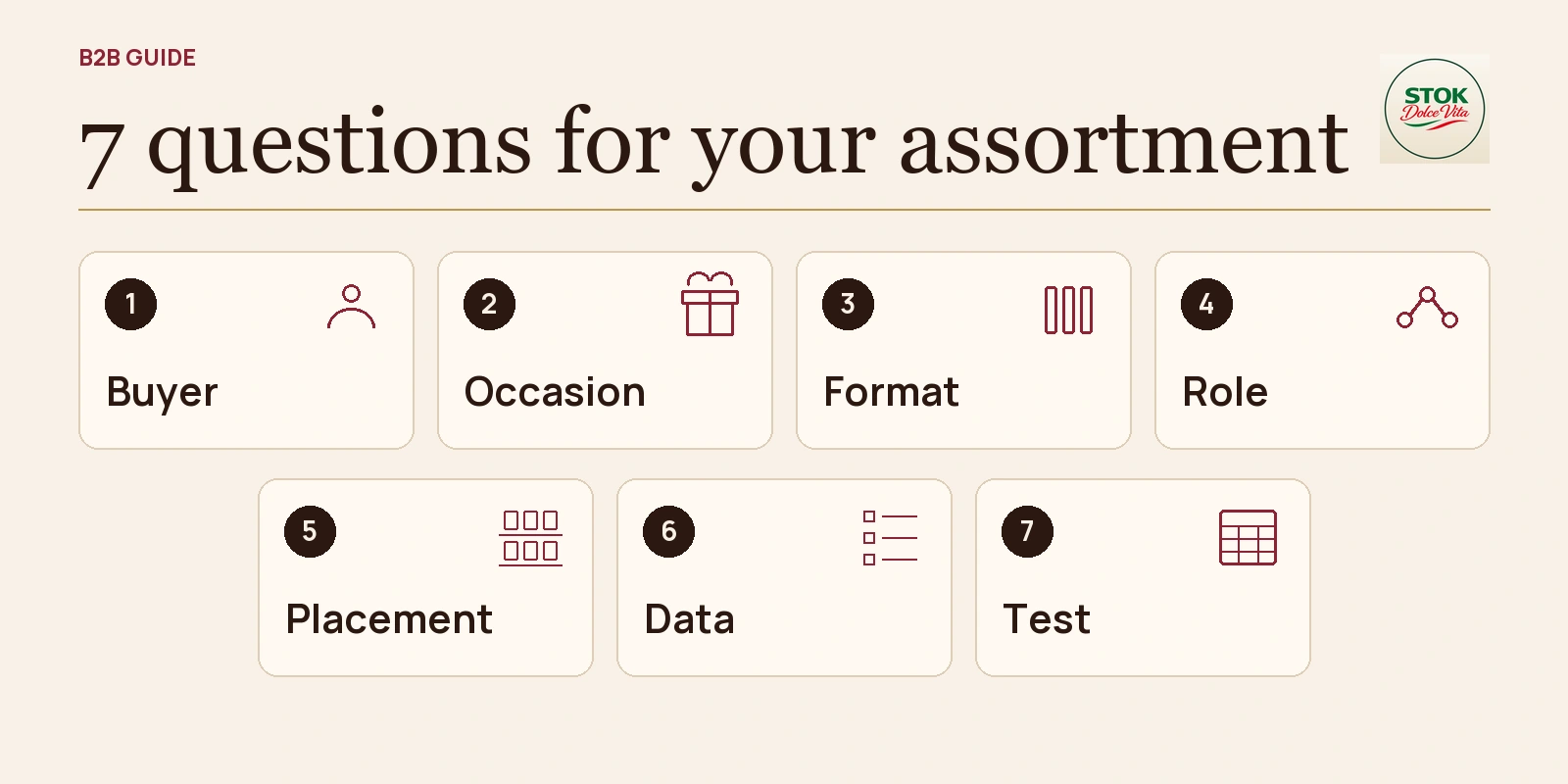
Assortment selection starts with the place of sale and the reason for buying. A wafer for a short break, chocolate for sharing and a box of chocolate bonbons as a gift serve different purposes. These seven questions help you connect those purposes with specific products, verified information and a small test in your business.
Every line in the assortment should have a clear purpose and a criterion for its next review.
Before opening the catalogue, define the task
Imagine a small shop with limited shelf space for confectionery. Several products in the catalogue look appealing, but every new line has to take space from something customers already know. The decision needs more than a comparison of flavours: you need to know why the new line deserves that space.
Write down a short starting hypothesis: who you are choosing for, when the product will be bought and what you plan to observe. For example: ‘We are looking for an individual format for people buying coffee to go.’ This is an illustrative trade scenario to test against the conditions in the business. The same approach can be used for a hotel reception, a café or a distributor's portfolio.
1. Who is buying, and what are they trying to do?
Describe the person at the moment of choice. Are they in a hurry, looking for a gift or buying something for home? In HoReCa, distinguish between two decisions: what your guest wants and what works for the team receiving, storing and serving the product.
For a neighbourhood shop, repeated customer questions and actual purchases at similar times of day can provide useful starting points. A distributor should first identify the types of outlet the selection will serve. A single list for cafés, food shops and corporate customers may conceal very different needs.
Express the task in one sentence. If it still reads ‘something sweet for everyone’, return to the specific situation.
2. What is the occasion?
An everyday break, sharing at home and giving a gift follow different patterns. Convenience and an easy choice may matter during a short break. For sharing, consider how the pack is opened and used. For a gift, think about presentation and how the customer will hand it over.
Rank the occasions by relevance to your business and separate everyday needs from seasonal ones. A shop near an office building could, for example, examine demand for personal consumption separately from demand for a small workplace gift. These are two hypotheses to observe. Give seasonal lines their own review period so they do not automatically become part of the permanent selection.
3. Which format suits the sale or serving occasion?
Format means more than weight: it includes the type and size of pack, the number of units and how the product will be used. An individual pack, a sharing pack and a gift box can fulfil different purposes even when their flavour profiles are similar.
Check the product's whole journey through your business. Does it fit the intended space? Is the front of the pack visible? Is it convenient for a takeaway purchase? If it will be served in a hospitality venue, match the exact product to your serving arrangements and the information guests need.
In trade data, distinguish the consumer pack from a display and an outer case. Confirm the number of units in each for the exact product. A larger pack does not, on its own, determine the right occasion or the number of portions.
4. What role does each product play in the selection?
A SKU is an individual product line with a specific code and set of characteristics. Two flavours or two weights usually need to be tracked separately. For each proposed line, finish the sentence: ‘It is included because…’.
Its role might be a familiar everyday choice, a different flavour, a format for a particular occasion or a limited seasonal addition. If two lines serve the same purpose, compare them carefully: do they provide a meaningful choice, or divide attention and space without a clear reason? Similarity does not automatically mean removing one; it is a reason to investigate.
When discussing the STOK Dolce Vita portfolio, consider Laica chocolate and chocolate bonbons, followed by Lago wafers and baked confectionery, according to their distinct product roles. Specific proposals depend on current information for the individual products.
5. Is there space and a clear logic to the layout?
Measure the usable space and view the selection from the customer's position. Can they quickly distinguish formats, flavours and price labels? Is there a clear reason for neighbouring products to be grouped together?
Rooderkerk and Lehmann studied layouts for biscuits and yoghurt snacks. Alignment with the way consumers group products was associated with perceived variety, choice complexity and purchase intention. This supports testing a layout customers can understand; the findings do not predict chocolate or wafer sales in your business.
Sketch a simple shelf or display layout. Mark the positions, visible pack fronts and price labels. Test one clear organising principle, such as format, and observe what happens before changing the other elements as well.
6. Have the product data and trade terms been verified?
Before ordering, match the code, exact product name, flavour, net quantity and image. Review the current label, ingredients, allergens and storage instructions. If a catalogue and a document disagree, ask for clarification about the specific version.
Commercial assessment also needs confirmed data. Compare the purchase cost with your planned selling price and applicable costs. Record the date of the quotation. A catalogue page or photograph does not replace current confirmation from the supplier.
- Product code and GTIN; consumer pack, display and outer case.
- Current availability, price and minimum order quantity, where applicable.
- Confirmed delivery timing and terms for the specific order.
- Shelf life and remaining shelf life for the proposed batch.
- Current label and storage conditions for the exact product.
7. How will you test the choice before expanding?
Start with a limited selection and a review period agreed in advance. Write down what you want to learn: is there demand for the format, is its position clear, and does it complement the category? Choose quantities that fit the confirmed terms and the capacity of your business.
Track units sold, availability, price, promotions and placement. One useful descriptive measure is ‘units sold ÷ days when the line was available for sale’. Keep out-of-stock days separate. If the product was available for only part of a day, record that limitation rather than treating the measure as fully comparable.
Look at the category as a whole, too. A new line may sell while a similar one loses purchases. Account for seasonality, changes in customer traffic, promotions and price changes. A short observation in one outlet can inform the next decision, but cannot isolate the cause of a change on its own.
- Record the starting selection, placement, review period and decision criterion.
- Change one main factor at a time when conditions allow.
- At the end, choose whether to keep, adjust, observe for longer or remove the line.
Bring the answers together on one sheet
For every candidate product, record the customer's task, occasion, format, role, placement, confirmed terms and review criterion. This keeps the reasoning visible during your next conversation with the supplier or your team.
Return to the same sheet when expanding the selection. A new flavour may meet an overlooked need, while a new size may duplicate a format that already works. Your answers will help distinguish the two situations and identify what deserves the next test.
For more on an initial test, read new products for independent shops.
Discuss a selection for your business
To discuss proposals from Laica and Lago, request the current portfolio. Tell us the type of outlet, the customer's task and the formats you are considering. This gives your conversation with STOK Dolce Vita a concrete starting point for checking suitable products and current trade terms.
Start with a specific task, choose a small selection and record how you will assess it. Expand when your observations and the confirmed terms give you grounds to do so.